
Share this Post
What is a Roth Conversion, and When Does it Make Sense?
Saving for retirement is not always as straightforward as “set it and forget it.” How and where you save can matter just as much as how much you save.
Many people accumulate most of their retirement savings in traditional 401(k)s and IRAs. These accounts provide valuable tax benefits while you are working, but withdrawals are generally taxable in retirement.
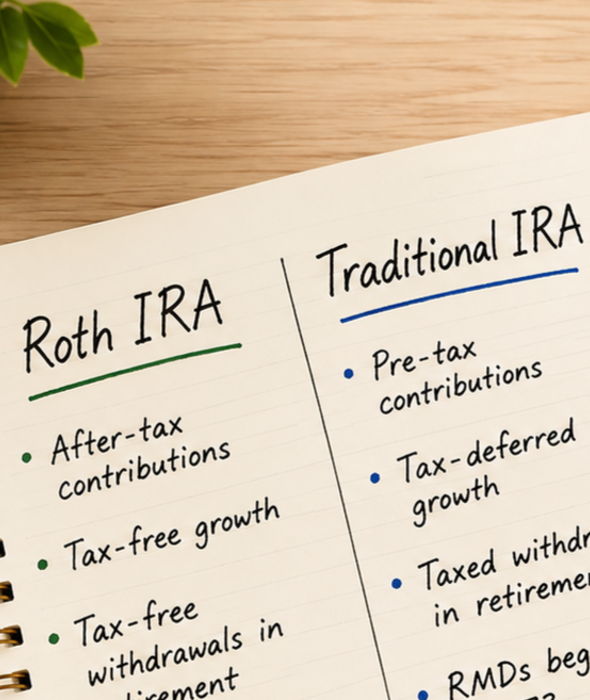
A Roth conversion gives you the opportunity to change that tax treatment by paying taxes today in exchange for tax-free qualified withdrawals in the future.
What Is a Roth Conversion?
A Roth conversion is the process of moving money from a pre-tax retirement account, such as a Traditional IRA or 401(k), into a Roth IRA.
The amount converted is generally treated as taxable income in the year the conversion occurs. Once the money is in the Roth IRA, it can continue growing tax-free, and qualified withdrawals are tax-free.
A Roth conversion does not eliminate taxes altogether. Instead, it gives you more control over when you recognize taxable income and pay the tax bill.
Why Consider a Roth Conversion?
1. Take Advantage of Lower-Income Years
One of the most common opportunities for a Roth conversion can occur during years when someone's taxable income is temporarily lower. For example, someone may retire at age 62 but wait until age 70 to begin Social Security. During those years, their taxable income may be lower than it was while they were working, and lower than it could be later once Social Security and Required Minimum Distributions (RMDs) begin. That window may provide an opportunity to convert a portion of their pre-tax retirement savings and recognize that income at a lower tax rate.
In simple terms: if you expect to be in a higher tax bracket later, it may make sense to intentionally recognize some taxable income today.
2. Reduce Future Required Minimum Distributions
Traditional retirement accounts eventually require you to begin taking Required Minimum Distributions (RMDs), generally at age 73 or 75 depending on your birth year. Those withdrawals create taxable income whether you need the money or not.
Roth IRAs do not require RMDs during the original owner's lifetime. Converting some pre-tax dollars earlier can reduce the balance subject to future RMDs and, in turn, reduce future taxable distributions.
3. Create More Tax Flexibility in Retirement
Having money across traditional, Roth, and taxable investment accounts gives you more options when deciding where your retirement income should come from.
If nearly all of your retirement savings are pre-tax, most withdrawals will create taxable income. Having different account types allows you to be more strategic about which accounts you draw from each year.
That flexibility can be valuable when managing your tax bracket, Medicare premiums, Social Security taxation, charitable giving, and other financial planning decisions.
4. Leave More Tax-Friendly Assets to Heirs
For many non-spouse beneficiaries, inherited retirement accounts must be emptied within 10 years.
Withdrawals from an inherited Traditional IRA are generally taxable to the beneficiary, while qualified Roth IRA withdrawals can be tax-free. That can make Roth assets particularly valuable when considering what you may eventually leave to children or other beneficiaries.
Important Considerations
Roth conversions are not a one-size-fits-all solution. There are several factors to consider before moving forward.
- You pay the tax today.
- A conversion can increase your taxable income for the year. Converting too much could push you into a higher tax bracket, increase Medicare premiums (IRMAA - Income-Related Monthly Adjustment Amount), or create other unintended tax consequences.
- Timing matters.
- Roth IRAs have specific rules that determine when earnings and converted dollars can be withdrawn tax- and penalty-free. This can be particularly important if you are under age 59½.
- Consider where the tax payment will come from.
- When possible, paying the conversion tax from cash outside the retirement account can allow more of your retirement savings to remain invested.
- After-tax IRA dollars can complicate the calculation.
- If you have made nondeductible contributions to Traditional, SEP, or SIMPLE IRAs, special tax rules (IRS Pro Rata Rule) determine how much of a conversion is taxable.
- Conversions cannot simply be undone.
- Under current tax law, Roth conversions cannot be recharacterized back to a Traditional IRA.
The Bottom Line
Roth conversions are not simply about paying less tax, but also focus on being intentional about when you pay it.
For some people, paying taxes earlier can reduce future tax obligations and create more flexibility in retirement. For others, maintaining pre-tax retirement savings may be the better choice.
Your current income, future RMDs, Social Security, Medicare premiums, retirement timeline, and estate goals can all affect the decision.
A good Roth conversion strategy is rarely one big decision. It is usually a series of smaller decisions made over time as part of your overall financial plan.